Jetson Orin
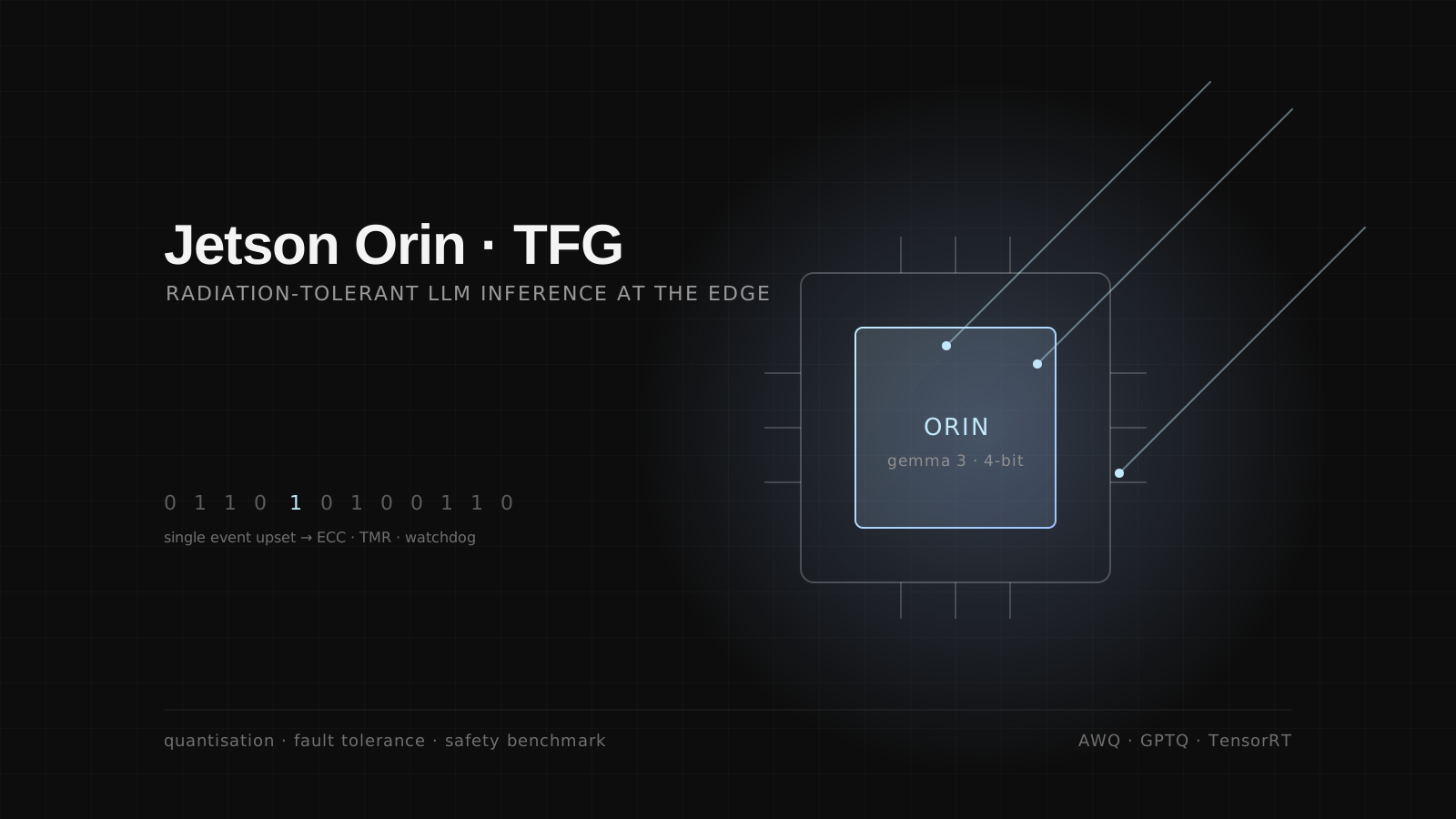
Spacecraft cannot phone home for inference. Latency to Mars is minutes each way, bandwidth is scarce, and the hardware that survives launch is a decade behind whatever is in your laptop. If you want a language model helping an astronaut, it has to run locally on a low-power board and it has to keep working while cosmic rays flip bits in its weights.
My thesis proposal takes that seriously across three pillars. The first is hardware-constrained optimisation: getting Gemma 3 onto a Jetson Orin Nano through AWQ and GPTQ quantisation, structured pruning, domain distillation, KV-cache management and retrieval instead of parameters.
The second is fault tolerance. Single event upsets are not hypothetical in orbit — they are a design constraint. I want to characterise which bit flips actually degrade model output (spoiler: not all of them matter equally), then evaluate ECC, triple modular redundancy and watchdog timers against a software bit-flip injection harness.
The third pillar is the one I care about most: an original benchmark for astronaut assistance with asymmetric, safety-weighted scoring. A model that says “I don't know” during a depressurisation event is behaving correctly; a model that confidently invents a procedure is not. Standard accuracy metrics score both the same. That's the gap.
Each pillar is designed to stand alone as an arXiv paper. Horizon: two years.
Services
Research, Edge AI, Thesis
Stack
Jetson Orin Nano, Gemma 3, AWQ/GPTQ, TensorRT
Status
Proposal · in definition
Year
2026 — 2028
Other Project
Multilingual Benchmark